Draft pending review by Climai Group
Heat pumps in Ibiza: what they are, how they work, what they need
In short
An air-to-water heat pump takes energy from the outdoor air to provide heating, cooling and hot water from a single unit. In Ibiza's mild climate it works in favourable conditions almost all year round.
Author: Climai Group technical teamTechnical review: [DATO PENDIENTE: técnico RITE de Climai Group]Updated:
What is an air-to-water heat pump?
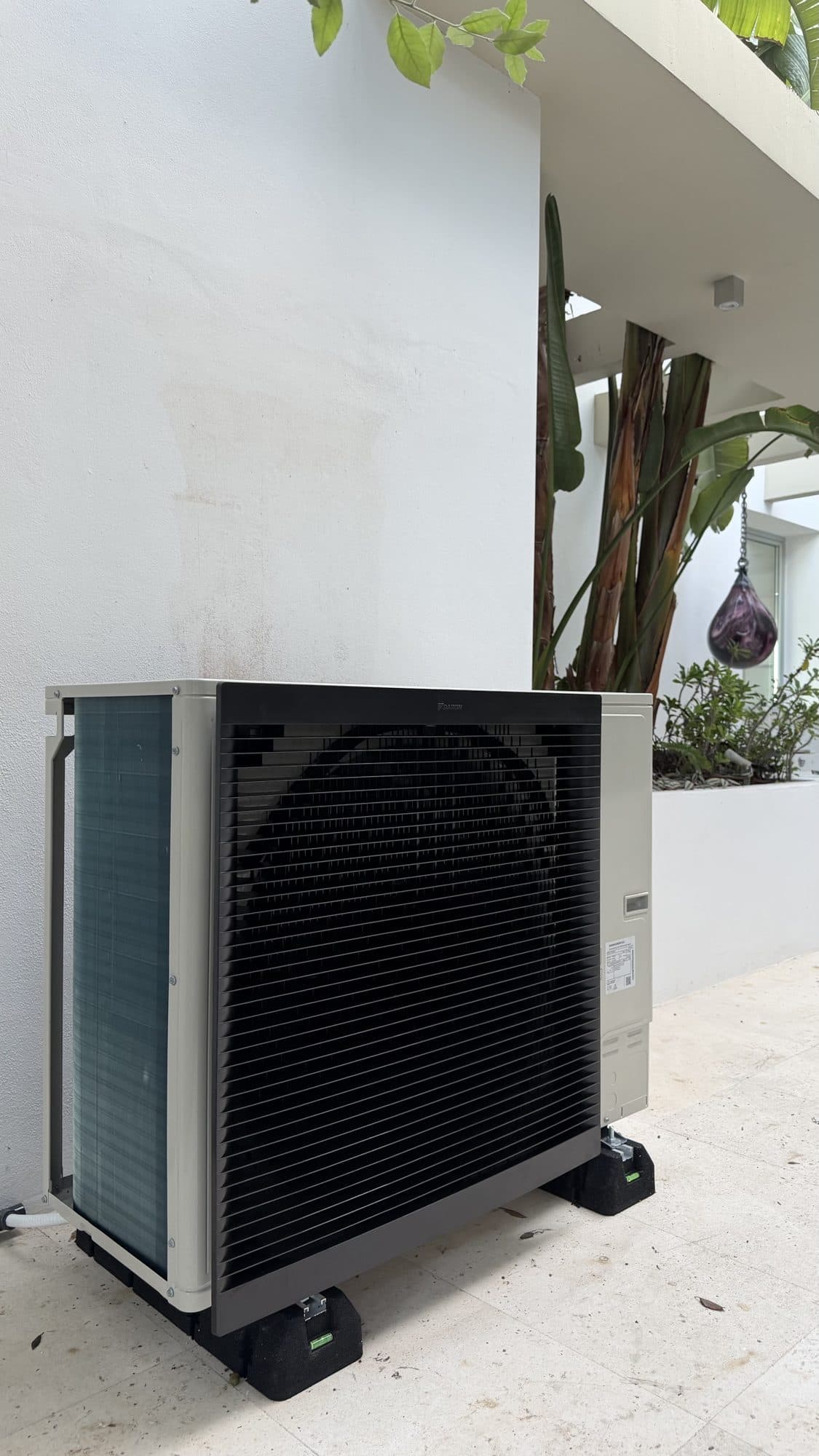
In Spanish it is called aerotermia: a heating and cooling system built around an air-to-water heat pump. The unit takes energy from the outdoor air and passes it to the water circulating through the house. That water heats the underfloor system, radiators or fan coils, and the hot water cylinder.
A single unit can provide heating, cooling and domestic hot water. That is why it replaces the boiler and, in many homes, the air-conditioning units as well.
How does an air-to-water heat pump work?
It works like a fridge in reverse. A refrigerant flows round a closed circuit and changes state to move heat from one place to another:
- Coil (evaporator): the very cold refrigerant absorbs heat from the outdoor air and evaporates, even in winter.
- Compressor: compresses the gas and raises its temperature.
- Heat exchanger (condenser): the hot gas gives up its heat to the house's water and turns back into liquid.
- Expansion valve: lowers the refrigerant's pressure and temperature, and the cycle starts again.
In summer, a reversible unit runs the cycle the other way: it takes heat out of the house's water and releases it outside.
| Component | What it does |
|---|---|
| Fan and coil | Move the outdoor air and capture its energy |
| Inverter compressor | Adjusts output to what the house needs |
| Control electronics | Run the cycle and talk to the thermostat |
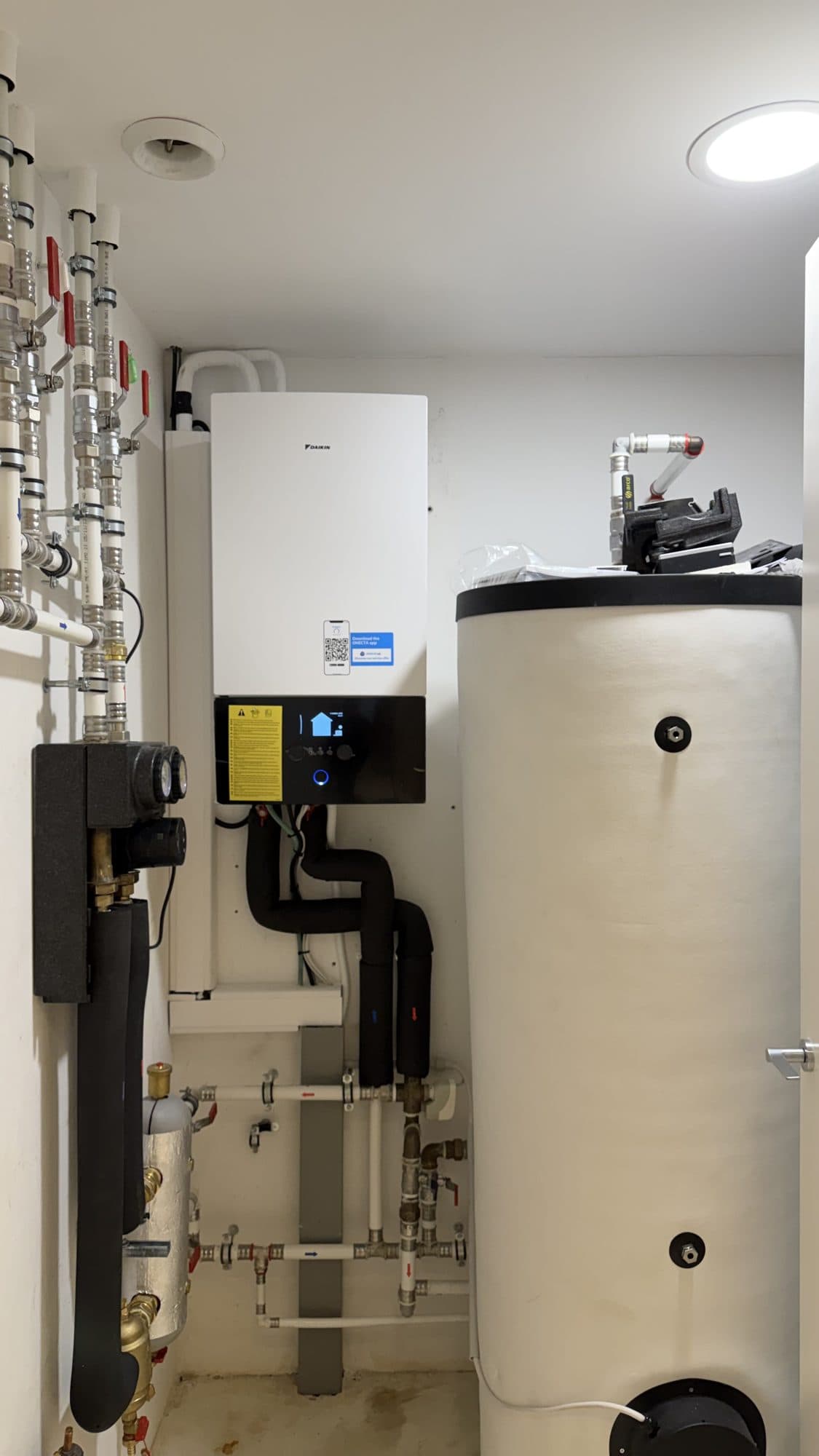
| Hot water cylinder | Stores hot water for showers and the kitchen |
What can it do in an Ibiza home?
- Heating through underfloor heating, low-temperature radiators or fan coils.
- Cooling through cooling underfloor systems or fan coils, if the unit is reversible.
- Hot water all year round with a storage cylinder.
- Pool heating, with a dedicated pool heat pump or a heat exchanger, depending on the case.
The island's mild winters suit a heat pump well: the smaller the gap between the air temperature and the water temperature it has to produce, the more efficient it is.
What do COP and SCOP mean?
- COP (coefficient of performance): how much heat the unit delivers for each unit of electricity it uses, under specific test conditions. A COP of 4 means it delivers four times the electrical energy it consumes.
- SCOP (seasonal COP): the same idea measured over a whole heating season. This is the useful figure for comparing units.
Both appear on the technical datasheet and the energy label. When comparing two units, look at SCOP at the same water temperature (35 °C for underfloor heating or 55 °C for radiators).
Monobloc or split?
| Monobloc | Split | |
|---|---|---|
| Where the refrigerant is | Only in the outdoor unit | Between the outdoor and indoor units |
| What enters the house | Water pipes | Refrigerant pipes |
| Installation | Simpler | Requires refrigerant work |
| When it fits | Almost always in homes | When the outdoor unit must be far away or space is very tight |
Which emitters work best?
The lower the water temperature the house needs, the more efficient the heat pump.
| Emitter | Typical water temperature | Heating | Cooling |
|---|---|---|---|
| Underfloor heating | Low (around 30–40 °C) | Excellent | Yes, as a cooling floor |
| Fan coils | Medium | Very good | Yes |
| Low-temperature radiators | Medium | Good | No |
| Standard radiators | High (around 50–60 °C) | Possible, with lower efficiency | No |
What do you need to install one?
- Space for the outdoor unit, with free air around it and away from bedrooms.
- Space indoors for the hot water cylinder and, depending on the unit, the hydraulic module.
- Enough electrical capacity. Some homes need a higher contracted power.
- A heat-load study to choose the right output: neither too small nor oversized.
- An authorised installer (RITE), who signs off and registers the installation.
Frequently asked questions
Is a heat pump renewable energy?
Is the outdoor unit noisy?
Do I need to replace my radiators?
Can it cool the house in summer?
How much space does it need?
Who can install it?
Shall we look at your home?
Estimate an indicative output or ask us for a quote. You deal with a single local installer.