Draft pending review by Climai Group
Replacing your boiler with a heat pump in Ibiza
In short
Almost any boiler can be replaced by a heat pump, reusing much of the existing system. The key is knowing what water temperature your radiators or underfloor system need.
Author: Climai Group technical teamTechnical review: [DATO PENDIENTE: técnico RITE de Climai Group]Updated:
Is it worth replacing a boiler with a heat pump?
Generally yes, when the boiler runs on heating oil, propane or electric resistance, or when it is near the end of its life. The heat pump provides the same heating and hot water while buying less energy, and adds cooling if the emitters allow it.
What matters most in the decision:
- What fuel you use today and how much you pay for it.
- What emitters you have: underfloor heating, radiators or fan coils.
- How well the house is insulated.
- Whether other work is planned, such as windows, roof or façade.
The actual saving depends on each home. The calculator gives a first estimate and the technical study refines it.
What can be reused from the current system?
| Element | Reused? | Comment |
|---|---|---|
| Underfloor heating | Almost always | We check its condition and balancing |
| Distribution pipework | Usually | Flushed before connecting the heat pump |
| Radiators | Depends | Their output at lower temperature needs checking |
| Hot water cylinder | Rarely | Usually replaced by one designed for heat pumps |
| Boiler and flue | No | Dismantled and removed |
| Fuel tank | No | Emptied, made inert or removed |
How do I know if my radiators will work?
A radiator gives less heat the cooler the water. The question is not whether the radiator works, but whether it gives enough heat at the temperature where the heat pump is efficient.
We check it like this:
- We measure each room and its heat loss.
- We note the type and size of each radiator.
- We calculate its output at the planned working temperature.
- If a room falls short, we propose replacing only that radiator or fitting a low-temperature one.
How does the work go, step by step?
- Site visit: we measure and check the system and the consumer unit.
- Study and quote: output, unit, cylinder and work required.
- Preparation: flushing the circuit and, if needed, electrical upgrades.
- Removal of the boiler, flue and fuel tank.
- Installation of the outdoor unit, hot water cylinder and connections.
- Commissioning: filling, bleeding, setting the heating curves and explaining how to use it.
- Registration: paperwork under the RITE.
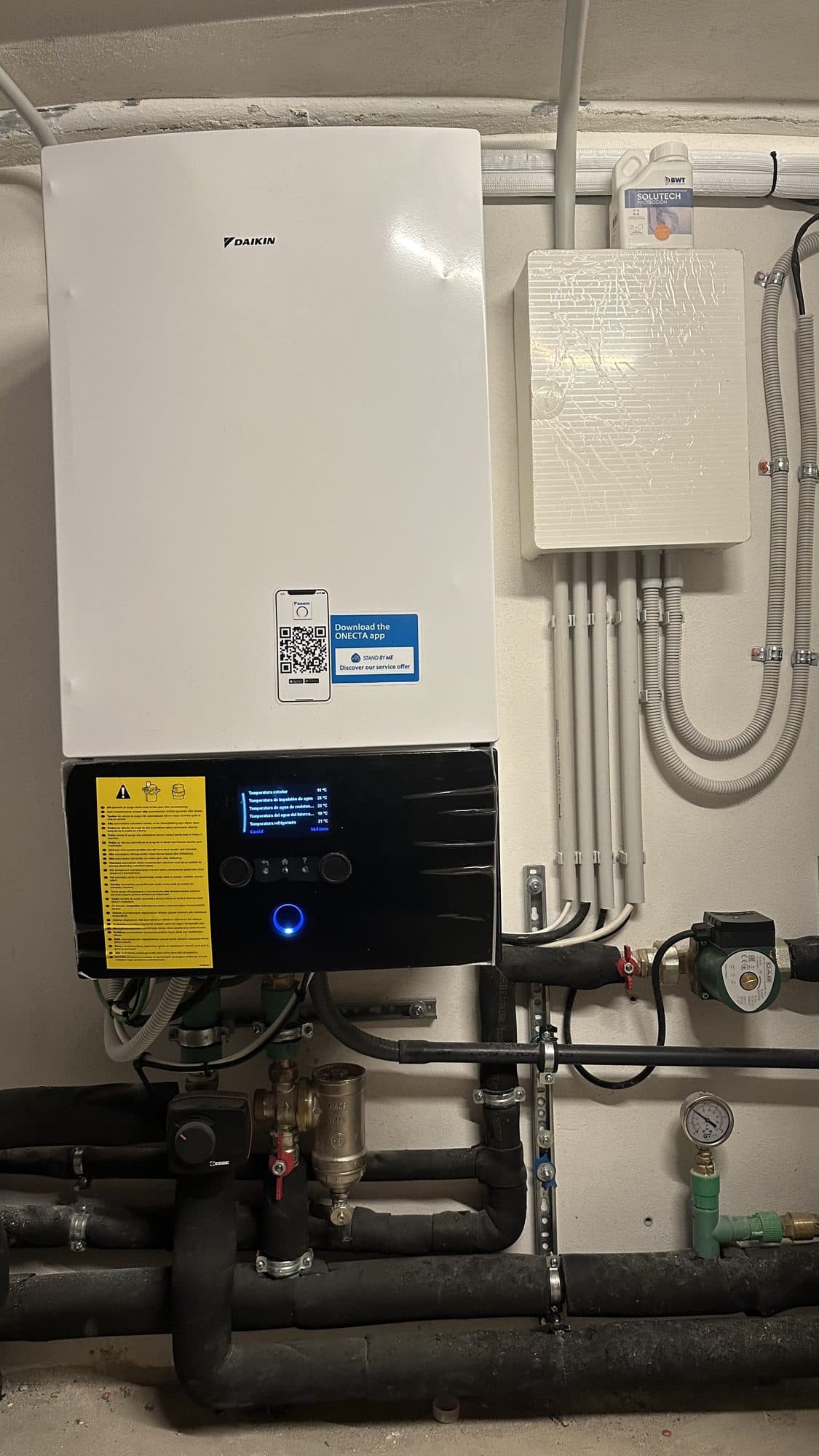
What changes day to day?
- No fuel to buy or deliveries to arrange.
- Heating runs continuously and gently, instead of firing at full power and switching off.
- Maintenance is different: periodic checks of the unit, filter and hydraulic circuit, with no burner or flue cleaning.
Frequently asked questions
Do I have to replace my radiators?
What happens to the heating oil tank?
How many days will I be without heating?
Can I keep the boiler as a backup?
Will I need more electrical capacity?
Are there grants for replacing a boiler?
Shall we look at your home?
Estimate an indicative output or ask us for a quote. You deal with a single local installer.