Draft pending review by Climai Group
Heat pumps with underfloor heating in Ibiza
In short
Underfloor heating works with low-temperature water, exactly where a heat pump is most efficient. With a reversible unit, the same floor heats in winter and cools in summer.
Author: Climai Group technical teamTechnical review: [DATO PENDIENTE: técnico RITE de Climai Group]Updated:
Why does underfloor heating suit a heat pump so well?
A heat pump is more efficient the lower the water temperature it has to produce. Underfloor heating warms a large surface, so lukewarm water is enough. Standard radiators need much hotter water to give the same heat.
| Underfloor heating | Standard radiators | |
|---|---|---|
| Water temperature for heating | Low (around 30–40 °C) | High (around 50–60 °C) |
| Heat pump efficiency | High | Lower |
| Cooling | Yes, with a reversible unit | No |
| Heat distribution | Even, from the floor up | Concentrated near the radiator |
| Wall space | Free | Taken by radiators |
How does the floor cool in summer?
With a reversible unit, the heat pump sends cool water through the same circuit. The floor absorbs heat from the room and the water carries it back to the outdoor unit.
It is a gentle, silent coolness with no draughts. It has two limits:
- It does not remove humidity. In the island's humid summers, comfort improves a lot with fan coils or a dehumidifier.
- Dew point. The water cannot get so cold that the floor condenses. The control prevents this with temperature and humidity sensors.
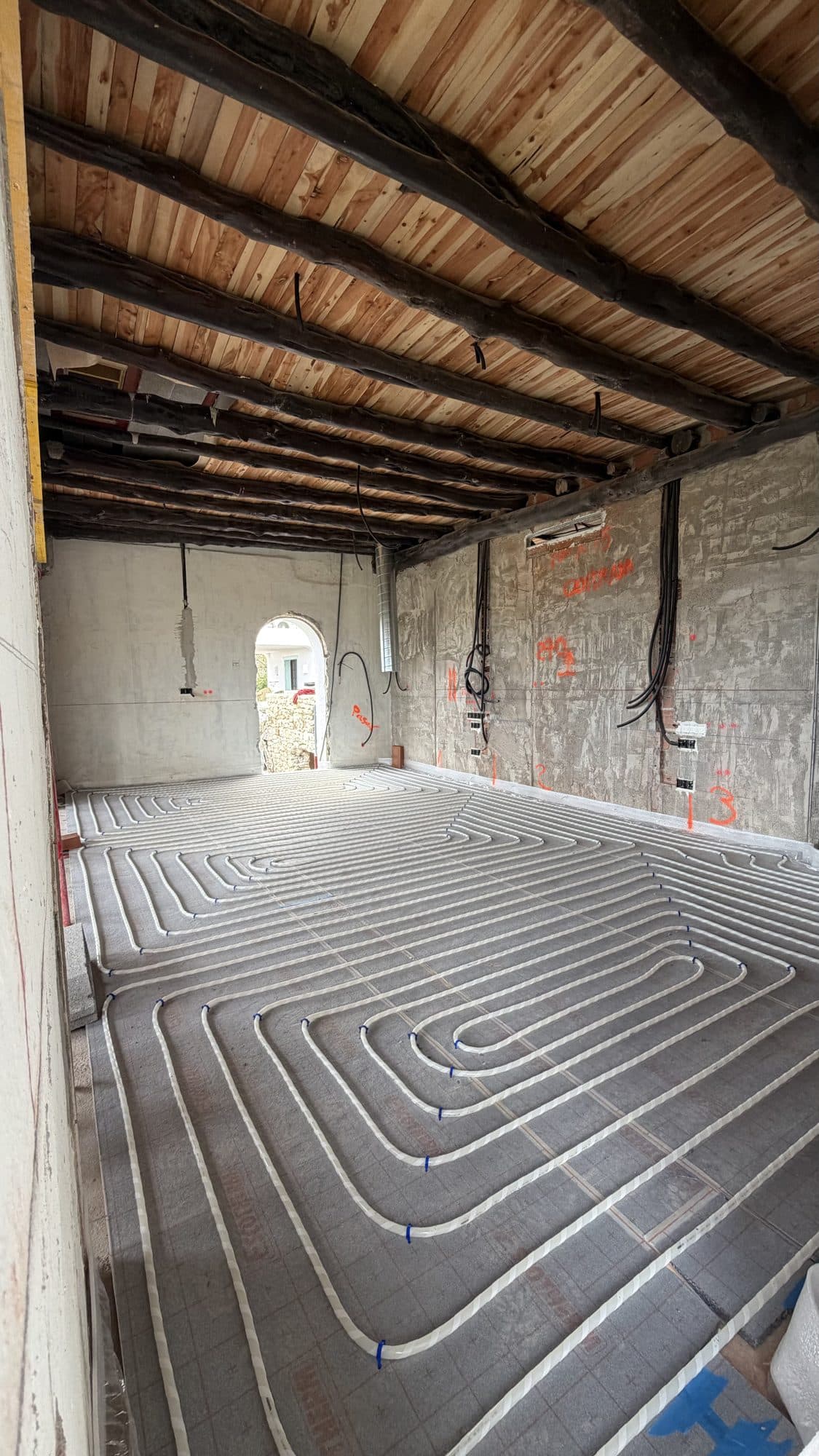
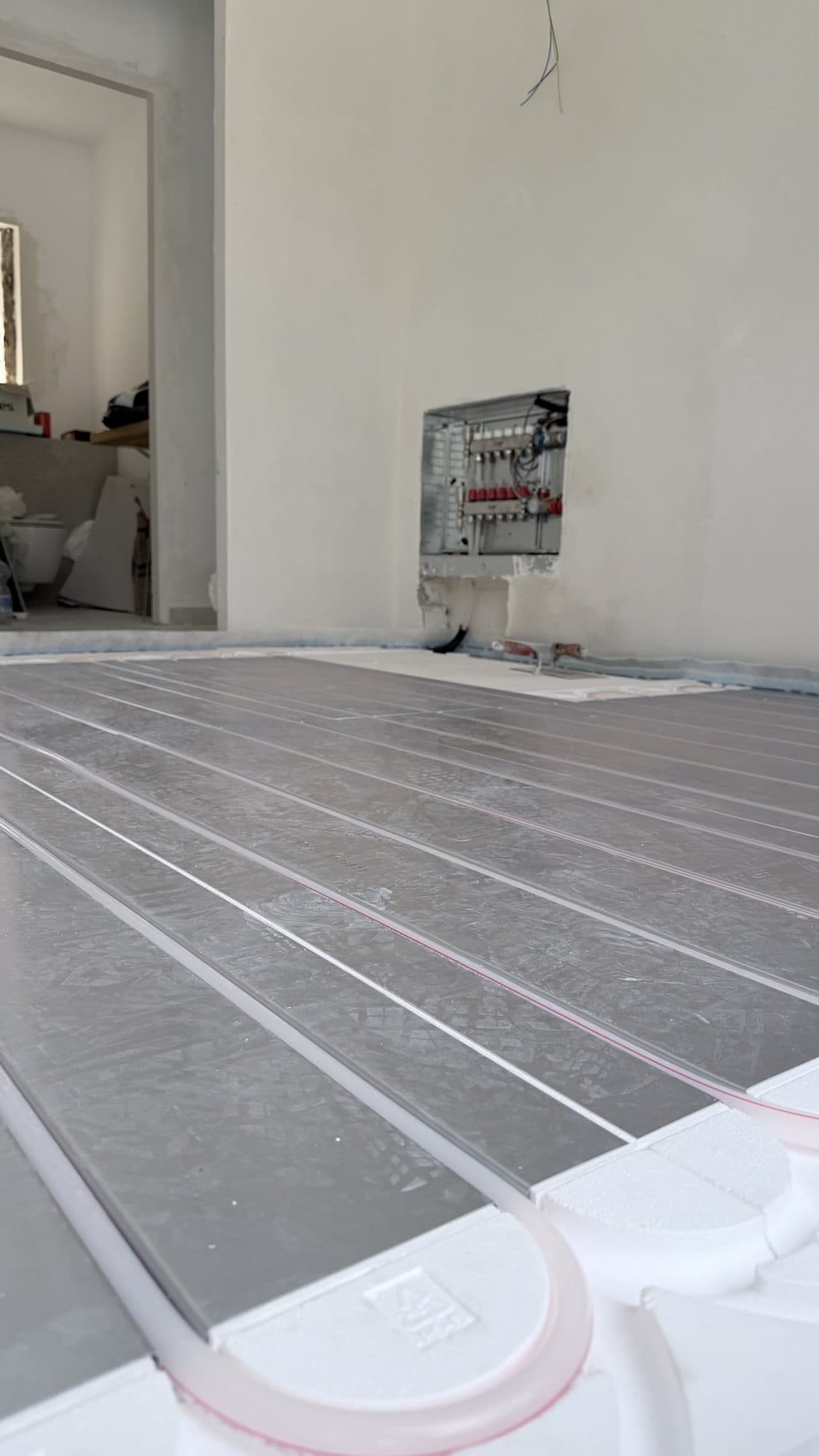
What does an underfloor heating system need?
- Insulation under the pipes, so heat goes up and not into the slab.
- Pipe (usually cross-linked polyethylene or multilayer) laid in circuits.
- Screed covering the pipe and spreading the heat.
- Manifold with one circuit per zone and balanced flow rates.
- Thermostats per room or zone, plus an outdoor sensor that adjusts the water temperature to the weather.
Can it be installed in a renovation?
Yes, although each case needs studying:
- Available height: renovation systems are thinner but still raise the floor by a few centimetres.
- Doors and steps: doors may need trimming or the first step adjusting.
- Floor slab: we check it can take the weight of the screed.
- Floor finish: if it is being replaced, choose one suitable for underfloor heating.
Which floor finish should you choose?
| Floor finish | Heat transfer | Comment |
|---|---|---|
| Ceramic and porcelain tiles | Very good | The most common choice |
| Natural stone | Very good | High thermal mass |
| Microcement | Very good | Thin layer over the screed |
| Wood | Fair | Only if the manufacturer approves it for underfloor heating |
| Vinyl | Fair | Check the maximum permitted temperature |
Frequently asked questions
Can I fit underfloor heating in an existing house?
Does an underfloor system cool as well as air conditioning?
What about condensation in summer?
Which floor finishes work best?
Does it take long to warm up?
Can each room be controlled separately?
Shall we look at your home?
Estimate an indicative output or ask us for a quote. You deal with a single local installer.